

Conference:
Irrationality and the Age of AI:
Language, Ethics, and the Future of Expression
The AI revolution has accelerated in recent years, propelled by the widespread use of large language models (LLMs). Today, AI systems are not only transforming technical environments but also shaping our thoughts, emotions, and everyday linguistic practices. Our conference will explore the role of affective computing, emotionally laden human-machine interaction, conversational AI models, reinforcement algorithms, and recommender systems in the wake of the LLM revolution. In this light, we will discuss what we can learn about language—both in its explicit, logical, grammatical structure and in its emotional, expressive dimension—when AI accesses these depths of human expression.

Book Launch:
Normative Ethics, Artificial Intelligence, and Value Alignment: From Normative Theory to Engineering Practices
We are hosting a book launch for Nicholas Kluge Corrêa's newly published book Normative Ethics, Artificial Intelligence, and Value Alignment: From Normative Theory to Engineering Practices. The book brings normative ethical theory to AI system development. It shows how we can align artificial intelligence (AI) systems with normative human values by training AI to follow human goals and values.
The event will take place on May 26, 2026, from 3 to 6 pm, at the Center for Science and Thought, and will feature talks by the author, as well as Prof. Dr. Markus Gabriel and Dr. Florian Mai.

Talk:
AI-Perspectives: Artificial Intelligence and AI
How does AI shape society—and who shapes AI? As part of the “AI Perspectives” series, this event explores AI from multiple perspectives.
On May 12, 2026, the focus is on feminism and AI, addressing bias, power structures, data justice, and inclusive design. With Toni Loh and Eva Maria Hille, we discuss how to create more equitable technologies and who is responsible.
Talk:
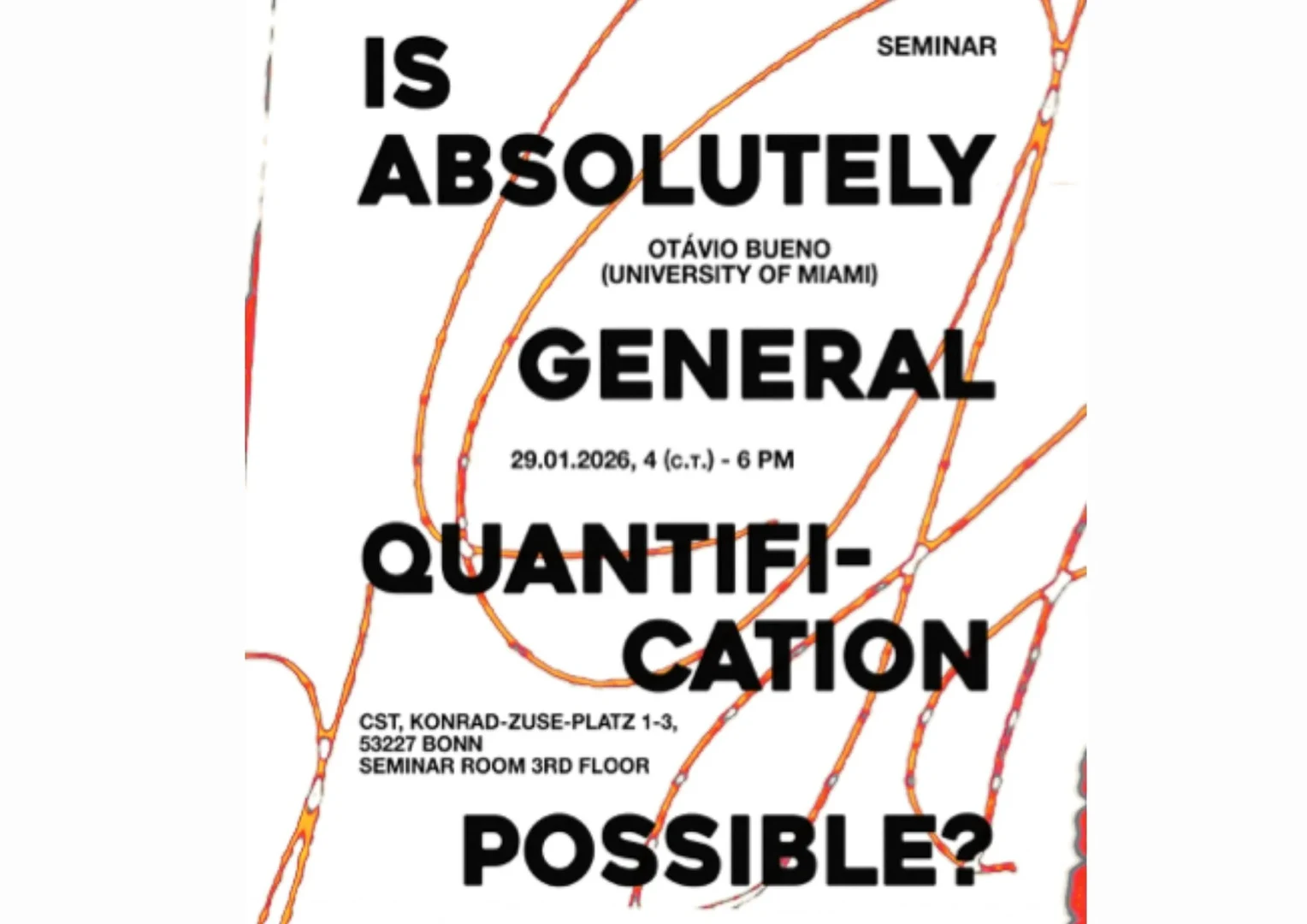
Is Absolutely General Quantification Possible?
The possibility of absolutely general quantification is often taken to be obvious, since even its critics appear to presuppose it. This paper critically examines and rejects standard arguments for that assumption. It then develops an alternative approach that acknowledges the inherent restrictions of every form of quantification. Second-order quantification is used as a case study to illustrate these restrictions and to contrast the resulting view with Hellman’s position.
Talk:
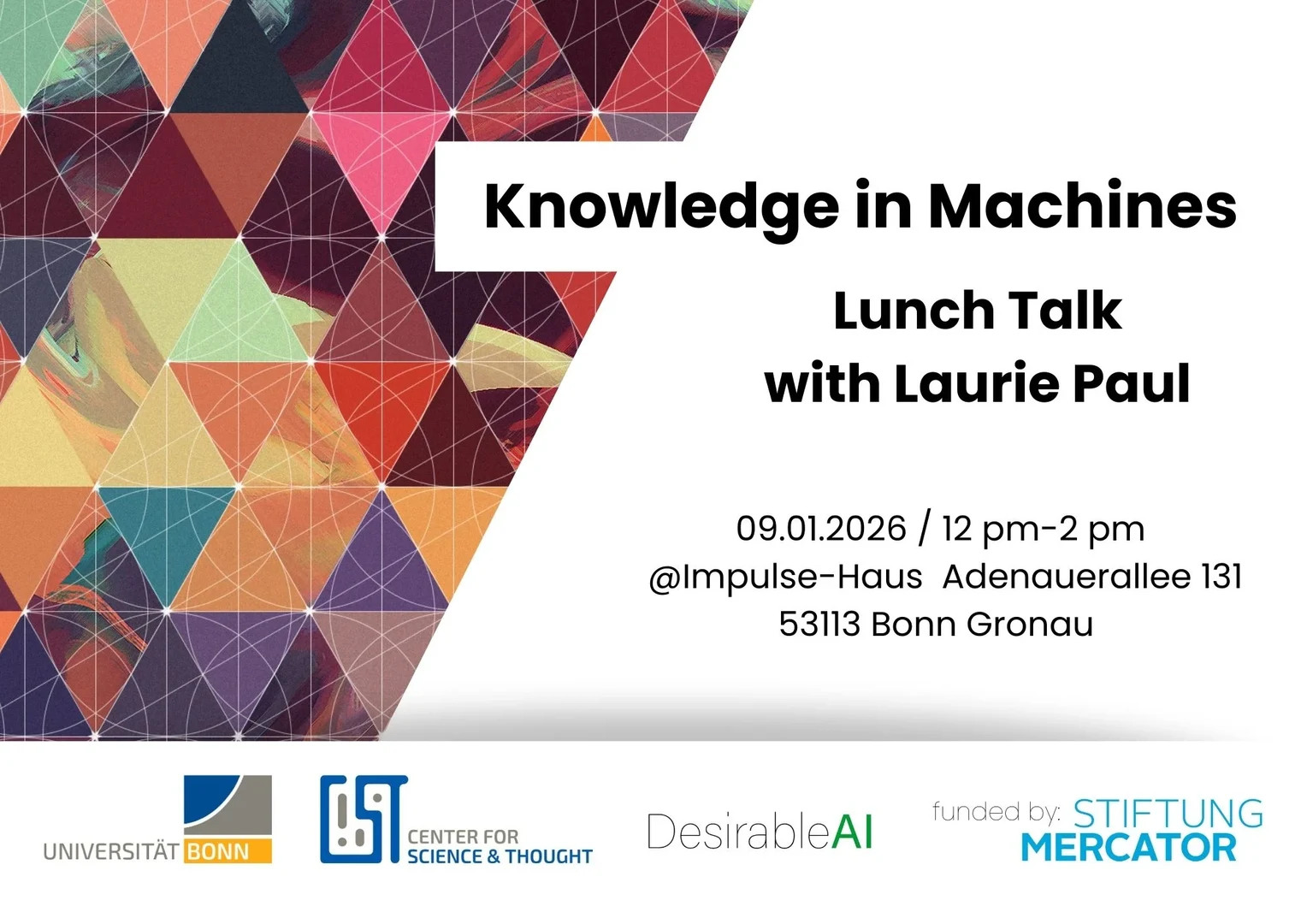
Lunch Talk with Laurie Paul
Drawing on philosophical epistemology, the lecture introduces a conceptual framework for knowledge in animals and machines. Guest speaker Prof. Laurie Paul (Yale) uses it to develop a new notion of LLM knowledge and to propose a taxonomy spanning biological and artificial systems—from C. elegans to LLMs. This approach clarifies how knowledge is realized across these different domains while accounting for their distinct biological and physical foundations.

Workshop
Developing LLMs for Low-Resource Languages
09-13 March 2026 @ IMPULSE-Haus
This Polyglot Workshop is a four-day, hands-on program focused on sharing expertise in building large language models (LLMs), with a special emphasis on underrepresented languages. Our goal is to empower a new generation of practitioners to advance LLM development beyond high-resource settings. The Workshop covers all key stages of an LLM training pipeline, making this knowledge accessible to a broad and diverse audience.

Talk (German)
"AI Explained": AI and ethical concerns
AI in search engines, on the phone, or in the defense industry – headlines about new developments seem to outdo each other every day. While the EU has adopted its AI Act, new technological possibilities are already emerging.
How can we use AI ethically and integrate our values into its design? The lecture explores ethical concerns and risks for individuals and democratic societies, while highlighting ways we can promote responsible technology development and use.

Seminar Series:
Cross-Cultural Approaches to Desirable AI, 2nd Edition
Following the success and strong interest in last year’s events, the online seminar series “Cross-Cultural Approaches to Desirable AI” continues this year, starting on October 22. The series aims to encourage intercultural and interdisciplinary discussion on the ethics of artificial intelligence (AI). Its primhttps://www.cst.uni-bonn.de/en/events/events-1/edit?_authenticator=b126c4a555b4087b7797604c18ad1632ef58074e#ary focus is to support and develop research on AI and social justice, particularly from intersectional feminist and anti-racist perspectives. “Cross-Cultural Approaches to Desirable AI” is a collaboration between the Universities of Cambridge, Bonn, and Tokyo, and the University of Europe for Applied Sciences.