Lecture: Turing Test 2.0 Reimagining the Goals of Artificial Intelligence in the Post-GenAI World
Monojit Choudhury is a researcher in artificial intelligence and computational linguistics whose work focuses on language, society, and human-centered AI. His research explores multilinguality, language variation, and the relationship between language technologies and human communication.
Since its inception, the Turing Test - the seemingly audacious vision of machines that speak with such fluency that they blur the boundary between human and artificial minds - has served as the north star of language understanding and AI. In the era of large language models, this vision feels tantalizingly close, yet increasingly hollow, as AI systems now routinely surpass humans not only in language-related tasks but across a variety of complex domains. This has led to a growing sense that we may be approaching, or have already glimpsed, the rise of Artificial General Intelligence (AGI) or even superintelligence. But this impression is misleading. Current systems excel at specific benchmarks, yet these tests often capture only narrow slices of what it means to truly understand language.
In this talk, Monojit Choudhury will argue that the real frontier lies elsewhere. Language is not a monolith but a living mosaic of individual voices, shaped by context, culture, and experience. To reduce it to a generic, averaged “human-like” performance is to miss its essence. He proposes a reframing, Turing Test 2.0, as the ability to model not an arbitrary human, but a specific individual. This shift echoes philosophical traditions that locate meaning in use, interaction, and lived reality. In doing so, it gestures toward a more ambitious and enduring vision: not merely to generate fluent text, but to engage with the human condition that language both reflects and constructs. Further he will argue that Turing Test 2.0 not only provides a theoretically grounded notion of generalization in machine learning, but also holds transformative potential for education, cognitive and psychological therapies, and social science research, among other domains.
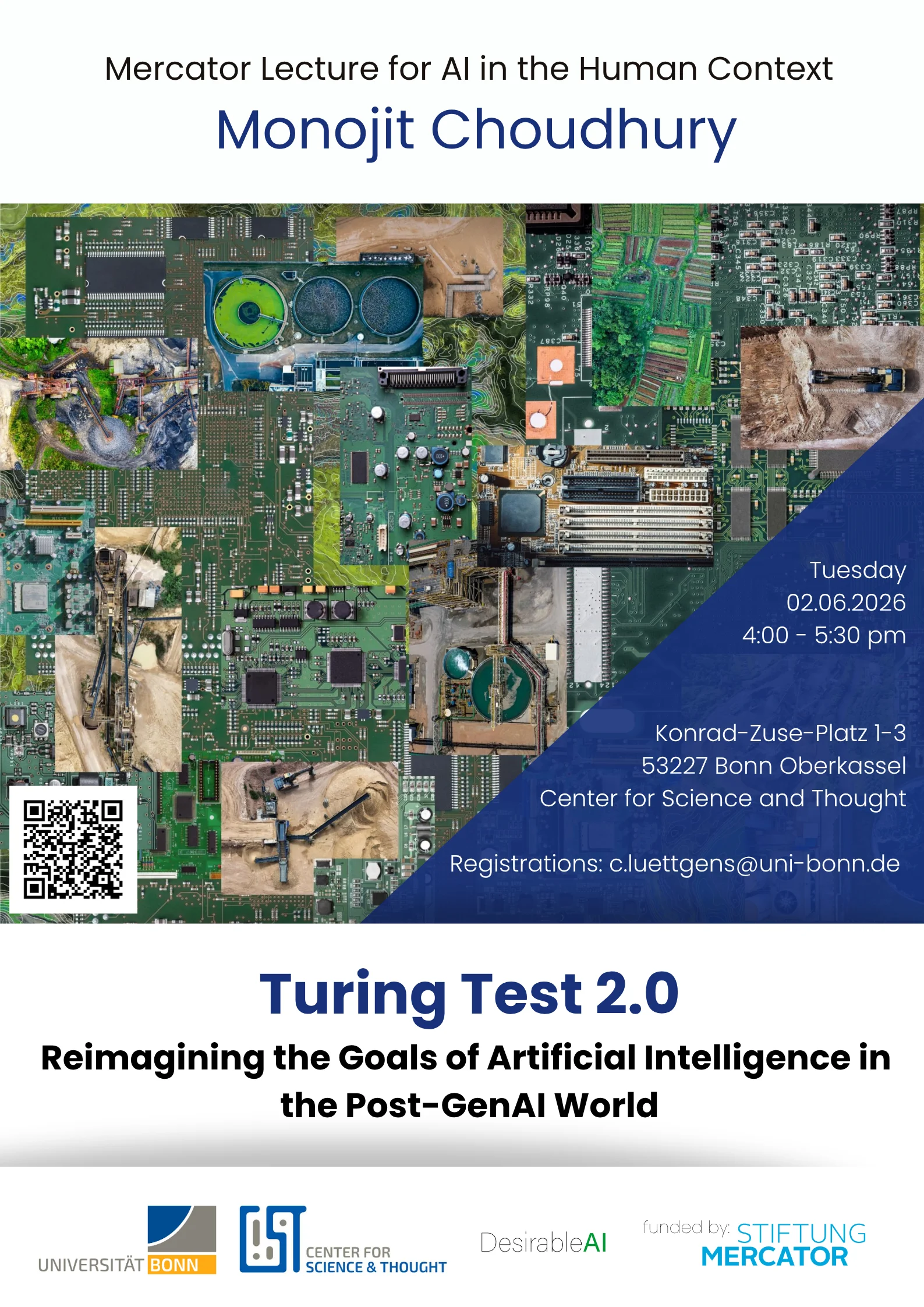
Registration and Date
Location
Center for Science and Thought
Konrad-Zuse-Platz 1-3
53227 Bonn
Date
Tuesday, 02.06.2026
4:00-5:30 pm
Registration
Please register via e-mail at: c.luettgens@uni-bonn.de
Desirable Digitalisation: Rethinking AI for Just and Sustainable Futures
Our research program is a collaboration between the Universities of Cambridge and Bonn and numerous international partners, and is funded by the Mercator Foundation in Germany.
We investigate how to design AI (artificial intelligence) and other digital technologies in a responsible way, placing the questions of social justice and environmental sustainability at the very heart of our work.
Contact and Organisation

Christiane Schäfer
Universität Bonn, Center for Science and Thought, Institut für Philosophie, Konrad-Zuse-Platz 1-3
53227 Bonn