
Welcome to the Center for Science and Thought
The Center for Science and Thought (CST) is a radically interdisciplinary platform designed to address urgent questions that arise at the intersection of philosophy and various natural sciences.
The CST is located at Konrad-Zuse-Platz 1-3, 53227 Bonn.
Current News of the CST

A conference exploring how different ‘schools’ of philosophy of technology interpret and respond to Artificial Intelligence. It invites contributions that approach Artificial Intelligence from within the philosophy of technology and reflect on how AI reopens fundamental questions of technics and technology across different traditions, conceptual transitions, and philosophical tensions.
Submission deadline: April 30, 2026

To support the work of the interdisciplinary research project "Desirable AI. Rethinking A.I. for Just and Sustainable Futures," we are looking for a Team Assistant (m/f/d) for 20 hours per week (50%).
Starting date: as soon as possible
Application Deadline: 22.03.2026
Duration: fixed-term until 31.03.2027

Date: December 18, 2025
Time: 7:00 p.m.
Venue: DZNE, Lecture Hall, Venusberg Campus
As part of the DZNE’s “Brain and Beyond” lecture series, Professor Markus Gabriel will give a talk on “Emotional AI.”
Here you can find additional news.
Events of the CST

This Talk will be held in German!
May 12, 2026 @ Deutsches Museum Bonn
How is artificial intelligence shaping our society—and who is shaping AI? As part of the “AI Perspectives” event series, a collaboration between the Deutsches Museum Bonn and the Center for Science and Thought at the University of Bonn, we explore AI design, use, and regulation from different angles, diving deeper with a range of guest experts.
This event focuses on the intersection of feminism and artificial intelligence, highlighting why feminist ethics are essential in technology development. Key topics include power structures, bias in algorithms, data justice, and inclusive design. Together with Toni Loh and Eva Maria Hille, we will discuss how technologies can be made more equitable and what responsibilities developers, companies, and society share in this process.

18-20 May 2026 @Universitätsclub
The AI revolution has accelerated in recent years, propelled by the widespread use of large language models (LLMs). Today, AI systems are not only transforming technical environments but also shaping our thoughts, emotions, and everyday linguistic practices. Our conference will explore the role of affective computing, emotionally laden human-machine interaction, conversational AI models, reinforcement algorithms, and recommender systems in the wake of the LLM revolution. In this light, we will discuss what we can learn about language—both in its explicit, logical, grammatical structure and in its emotional, expressive dimension—when AI accesses these depths of human expression.
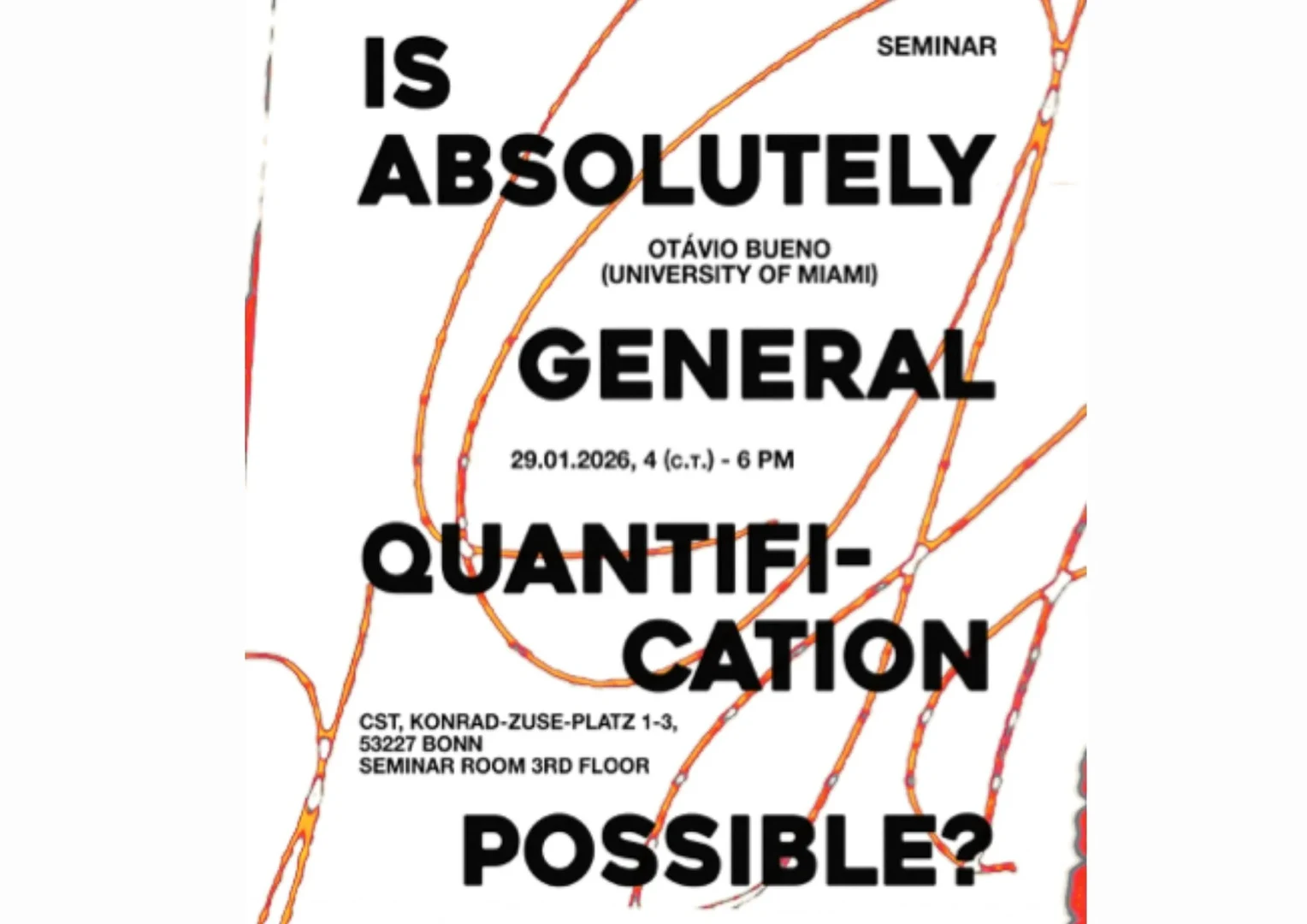
The possibility of absolutely general quantification is often taken to be obvious, since even its critics appear to presuppose it. This paper critically examines and rejects standard arguments for that assumption. It then develops an alternative approach that acknowledges the inherent restrictions of every form of quantification. Second-order quantification is used as a case study to illustrate these restrictions and to contrast the resulting view with Hellman’s (2006) position.
Here you can find more events.
Research of the CST

The aim of the project is to develop procedures to examine generally accepted standards for AI systems and their verification, as well as to explore business models for an AI certification. Our research investigates the ethical-philosophical significance of these dimensions.

Rethinking AI for Just and Sustainable Futures.
We investigate how to design AI (artificial intelligence) and other digital technologies in a responsible way, placing the questions of social justice and environmental sustainability at the very heart of our work.
Our research program is a collaboration between the Universities of Cambridge and Bonn and numerous international partners, and is funded by the Mercator Foundation in Germany.

Polyglot: Developing Open Source Foundation Models for Low-Resource Languages
Polyglot is an initiative to close the linguistic divide in NLP by developing efficient and accessible foundation models for low-resource languages.
Polyglot is a project funded by the Federal Ministry of Education and Research (BMBF) and the Ministry of Culture and Science of the State of North Rhine-Westphalia (MWK) as part of TRA Sustainable Futures (University of Bonn) and the Excellence Strategy of the federal and state governments.
You can find more information about our research projects here.

We connect female* students, scientists at all career levels as well as employees from technology and administration who research and work in various disciplines on artificial intelligence (AI) at the University of Bonn.
Our goal is to bring women* at the University of Bonn together, increase their visibility and engage in a critical exchange about AI. As a female* network, “Feminist AI” supports the interdisciplinary dialog on artificial intelligence and contributes to the strengthening of female* researchers at the University of Bonn.
The network is supported by the Equal Opportunities Office of the University of Bonn with funds from the Fund for the Promotion of the Structural Anchoring of Gender Equality.

You can find a selection of publications here.

Register here here for our AI-Mailinglist.